Monthly vs Yearly Rent in the UAE: Which Suits New Expats Better?
Your biggest expense from the moment you set foot in the UAE is housing. Rent and the security deposit can take up a large part of your salary.
But finding a house with cheaper rent and a low upfront cost is not enough to settle in without financial stress. You also need to find a balance between paying for a home you like and having enough money to cover your other expenses.
Rental payments in the UAE can work in different ways. Annual rentals often involve paying through multiple cheques, which can mean a large amount of money is committed upfront. Monthly and short-term rentals can cost more in some cases, but they give you more flexibility and may require less money at one time.
This guide compares monthly and yearly rent in the UAE to help you choose the option that best fits your income, savings, and financial needs.
Monthly vs Yearly Rent: What New Expats Need to Know
Before choosing a rental option, it helps to understand how monthly and yearly rent work in the UAE. The payment method can affect how much money you need at the start and how flexible you can be later.
1. Understand What “Monthly Rent” and “Yearly Rent” Actually Mean
Monthly rent usually means you pay for your accommodation every month. This is common with short-term rentals, serviced apartments, and some other flexible rental options. You may have to pay a higher monthly amount, but you do not need to commit to a full year.
Yearly rent means you sign a tenancy agreement for one year. This does not always mean you have to pay the full year's rent in one go. Many landlords accept rent through multiple cheques during the year.
Depending on the property and landlord, you may be able to pay the yearly rent in 1, 2, 4, 6, or 12 payments. The available options can vary, so it is important to ask about the payment schedule before signing the agreement.
For a new expat, this difference matters because your rent payment can affect how much money you have available for your other monthly expenses of settling in.
2. Yearly Rent Can Be Cheaper, but Requires More Financial Commitment
Yearly rent can cost less than monthly rent over the full year. However, it may require you to pay a large amount of money at one time.
For example, a yearly apartment may cost AED 36,000. A similar apartment with monthly rent may cost AED 3,500 per month, which would be AED 42,000 for a full year. This means the yearly option saves you AED 6,000.
But if the AED 36,000 yearly rent has to be paid in two cheques, you may need to pay AED 18,000 at the start, even before you move in.
This may not be easy for a new expat because you also need money for the security deposit, food, transport, phone bills, furniture, and other monthly expenses.
So, when comparing the two options, do not look at the total rent alone. The cheaper option may not be the easier one if the upfront payment uses most of your savings.
3. Monthly Rent Gives New Expats More Flexibility While They Settle In
When you first move to the UAE, you may not know which area is best for you or how much you will spend each month. Your workplace, daily travel, and other needs may also change after you arrive.
Monthly or short-term accommodation gives you time to understand what works for you before signing a yearly rental agreement. You can live in an area, see how long your daily commute takes, and check if the rent fits your budget.
Monthly rent may cost more, but the extra cost can be useful when you are still settling in. It gives you the freedom to move later if the area does not suit your work, commute, or daily life.
4. The Number of Rent Cheques Can Make a Big Difference to Your Cash Flow
The number of cheques decides how much you pay at one time. For example, a landlord may offer a yearly rent of AED 36,000 if you pay in two cheques, but charge AED 38,000 if you pay in 12 cheques. With two cheques, you pay AED 18,000 at a time. With 12 cheques, you pay about AED 3,167 each month.
Fewer cheques can mean a lower total rent, but each payment is larger. More cheques can make payments easier to manage, but the total rent may be higher.
Payment options vary by landlord and property. If you prefer smaller payments, ask if a 12-cheque option is available and compare the total rent before signing.
5. Don’t Compare Rent Alone, Calculate the Full Move-In Cost
The rent is only one part of the cost of moving into a home. You may also need to pay:
- Security deposit: Money paid to the landlord that may be returned when you move out, depending on the rental agreement and the condition of the property.
- Agency commission: A fee charged by a real estate agent for helping you find and rent the property.
- Ejari registration: A registration fee may apply when registering your tenancy contract in Dubai.
- Utility costs: You may need to pay deposits or connection charges for electricity, water, cooling, and other services.
These costs can add a large amount to what you need before moving in. So, before signing, check the total amount you need to pay, not just the advertised rent.
Before signing the agreement, calculate the total amount you need to move in and check how much money you will have left for your regular expenses.
6. When Monthly Rent May Make More Sense for a New Expat
Monthly rent may make more sense for new expats who need time to understand what works for them as they settle into life in the UAE. It can be useful if you are:
- Still exploring where to live: You want to try different areas before choosing a permanent home.
- Unsure about your job or location: Your workplace or daily commute may change.
- Managing several moving costs: You need money for furniture, transport, food, phone bills, deposits, and other setup costs.
- Still understanding your monthly spending: You need a few months to see how much you actually spend on rent, food, transport, and other needs.
7. When a Yearly Lease May Be the Better Financial Choice
A yearly lease may suit you if you are settled in your job and location and have enough money for rent, regular expenses, and emergencies. It may be a good fit if you:
- Know your location and commute: You are comfortable with where you live and work.
- Have enough savings: You can cover the rent and move-in costs without using all your savings.
- Plan to stay for at least a year: You do not expect to move soon.
- Can manage the payment schedule: You are comfortable with the number and size of rent payments.
Need an instant loan? Download the CashNow app today.
8. How to Avoid Draining Your Cash Just to Secure a Home
The general rule of thumb is to not spend all your available money on rent and move-in costs, and keep enough cash for regular expenses, bills, and unexpected costs. But, just in case you do end up spending all the money you have or find yourself short on funds anytime during the month, you can choose to avail a temporary financing solution, like a microloan.
CashNow offers short-term financial support to bridge a cash crunch. However, it should not replace proper rent and budget planning. Make sure you can afford the repayments along with your regular expenses before borrowing.
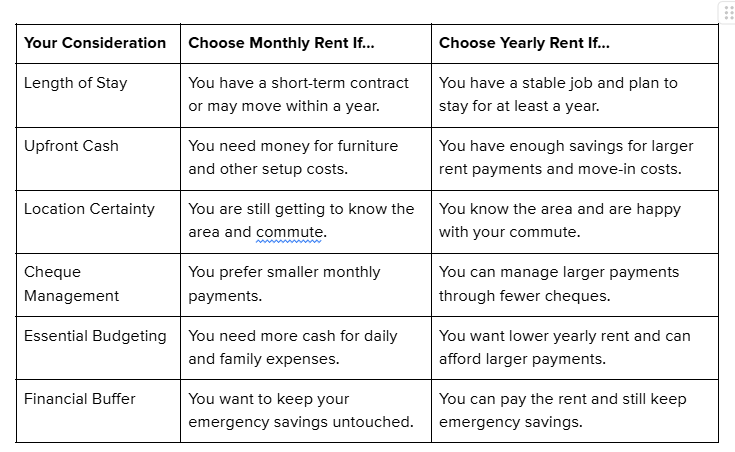
Monthly vs Yearly Rent: A Quick Decision Checklist for New Expats
Use this quick guide to see which payment option best fits your current situation:
Conclusion
The rental option that works for others may not work for you. Your cash flow, emergency fund, savings, and budget are different from theirs. Consider these factors when choosing between monthly and yearly rent.
Monthly rent can give you more flexibility when you are still settling in. A yearly lease may offer lower total rent if you are ready to stay in the same home and can manage the larger payments.
Keeping enough cash available during your first few months in the UAE can make it easier to settle in. If you still face a temporary cash-flow gap for essential expenses, CashNow’s microloan option may help cover up to AED 5,000.
Need an instant loan? Download the CashNow app today.
Similar Content